
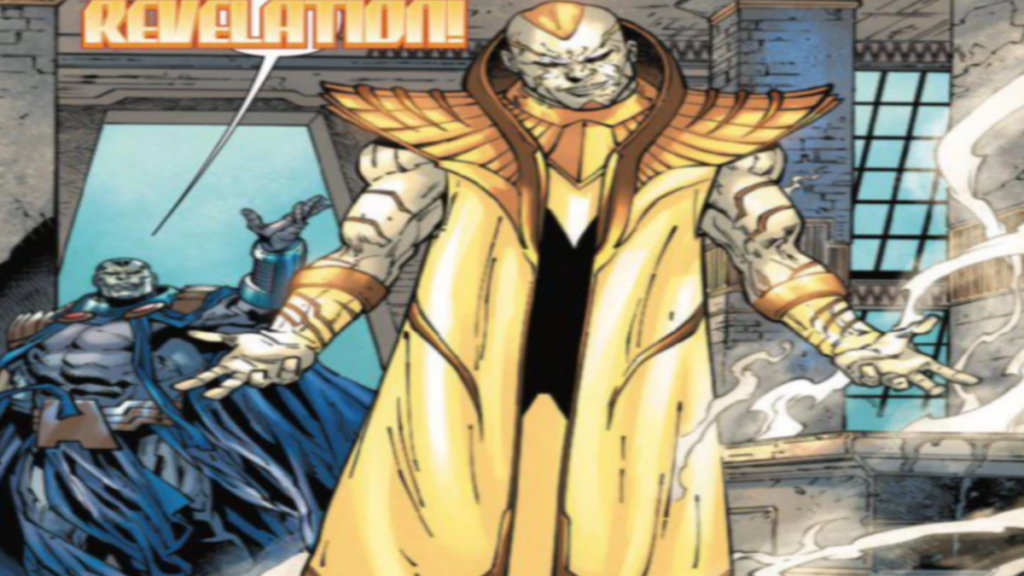
A good name is more desirable than riches according to the opening line of Proverbs 22. But are we meant to interpret the prophet’s use of the words “good name” in terms of fit or fitness: cleverness or character? This becomes a bigger concern once you read the scriptures second verse that adds a caveat that can be easily misconstrued. Being esteemed can not only imply the moniker means something, but that the named individual has earned and continuously embodies the title given.

The 616 Marvel Universe is overflowing with “names”, both heroic and villainous. Some that resonated with fans of the comic books since day one and continue to this very day. Although to tell the truth as names go, compared to his fellow explorers, Mr. Fantastic doesn’t say a whole lot about what the man can accomplish, which, If you know Reed Richard, doesn’t happen very often. Wonder Man is yet another one that you might find to be a bit ambiguous. And does anyone actually scream for Eye-Scream?
Some names are symbolic, others anti-establishment, take Captain America and Flag Smasher for instance. Then you have Mirage, Roulette and Blink, representing characters whose names utilize a bit of clever word play to convey their powers. How they have power over nature, or describing what they are made of as seen with Storm, Dust and Mercury. Or take Cyclops, Colossus and Tempest, whose titles are intended to describe their powers by comparing them to famous mythological figures. Marvel readers will even encounter several instances where names have belonged to – or even are still being used by – multiple characters, let’s see there’s Captain Marvel, Captain Britain and Psyclocke. Or even better yet, there are names like Hulk and Wolverine that both describe several individuals and all of them together as a collective. Some names like Angel, Elixir and Hope that immediately invoke expectations of help and healing for others, while those like Gambit, Domino and Mystique establish how the characters choose to live their lives.

However, from The Watchers Blue Area of the Moon to the Dark Dimension of The Dread Dormammu there is one name that until today didn’t mean much: Cypher.
Actually, that was a poor choice of words. In fact, in terms of the name matching the ability, the one Douglas – also known as Doug – Ramsey chose is as good as they come. The codename comes from the word cypher – also spelled cipher – which incidentally means a code. For the most part any definition you find of the word will refer to it as a secret, special manner of writing that isn’t immediately recognizable to the uniformed or unobservant. Given that a cipher can contain letters, numbers or even symbols it is possible that a comic book, like the X-Men lineup of comics that Cyper has appeared in throughout the years, could be an example of one. By that logic the same would even be true of comic book covers.

Which as now everyone knows was the case back in 2022 when the Mark Brooks cover for Immortal X-Men #1 hit store shelves. Similar to the actual storylines that occurred during the X-Men’s Krakoan Age, if you were paying attention that particular illustration provided a previously unknown secret. And just as the X-Men are starting to rise From the Ashes, information arrives that will again alter the lives of mutants – and so many others as well.
Because while Cypher may have meant zero to the other Marvel heroes, Douglas Ramsey’s new codename and mission are a divine disclosure. Marvel Comics welcomes the 616 Universe and readers to The Age of Revelation.
No More Words
Realistically, outside of religious texts, the word revelation doesn’t really mean too much. However, because of this supernatural association everyone tends to get anxious and uneasy at the mention of the word. But in reality it isn’t meant to be frightening, in fact it’s doing you a favor. Fear of the unknown is one of humanity’s primary fears, so why does the mention of a disclosure that potentially could bring about closure cause us such dread? Then again when it comes to names, considering Revelation is the heir of Apocalypse, this could just be a case of like father like son.

Douglas Ramsey’s introduction to the X-Men wasn’t a huge event, but looking back it was unique. Over the years there have been tear filled, emotional arrivals like Rogue and others, like Jubilee, that were barely noticed. However, Doug’s very first X adventure began at neither the school nor as a stowaway, it was at a dance studio in Uncanny X-Men # 177. Living in Salem Center, Doug attended Stevie Hunter’s dance studio. Unbeknownst to most of Salem Center, Stevie was also an affiliate of Xavier’s. In fact Katherine (Kitty) Pryde was one of her students also, and both she and Douglas became friends due to their shared interest in computers and hacking. An interest in the Hellfire Club turned obsession eventually led Kitty to seek out Doug’s aid to infiltrate the files of the Hellfire Club, and their leader Sebastian Shaw. Soon after, Doug received an invitation to visit, along with an offer of a full scholarship to attend the Massachusetts Academy, Unable to dissuade him from the visit, Kitty sought Professor X’s blessing to tag along. To her disbelief it was at this moment that Xavier revealed that Doug was a mutant. However, Xavier felt due to the passive nature of his power Doug didn’t belong at the school for gifted youngsters.
Because initially Douglas Ramsey’s powers were linguistic, with his ability initially being limited to written or visual text. But his abilities began to expand after the introduction of Doug’s self proclaimed SELFFRIEND: Warlock. After an alien crashes down close to Xavier’s School for Gifted Mutants in New Mutants # 21, the adolescent team of X-Men known as the New Mutants go to investigate. At the site they discover a young Technarch creature that they are unable to communicate with. After an unsuccessful battle, Samuel Gutherie flies off to retrieve the one individual he knows can help. That night Douglas Ramsey receives many revelations with the existence of aliens like Warlock being the least significant. The fact that Sam is a mutant named Cannonball is easily number two. The biggest shock has to be that not only is Doug a mutant, but that people he considered to be friends knew about it and kept it from him. Maybe calling him Cypher had nothing to do with encryption and was because he was meant to be a secret.


One thing that is no secret to longtime readers is the inseparable bond this early adventure created between Cypher and Warlock, otherwise known as Team Supreme. Though their first few collaborations consisted of Cypher wearing Warlock like a suit of armor, an attempt to free a computer controlled Betsy Braddock from the media obsessed Mojo forced to consider an extreme option. By merging their essences, allowing Warlock’s techno organic circuitry to interface with Cypher, the two allies could coexist in a temporary symbiosis. This maneuver was not without risk as a prolonged exposure to the Techno Organics that comprised Warlock would infect Douglas with a lethal TO virus, forever transforming Cypher into a technarch. This fact did not dissuade the duo, and not only did they merge and manage to stop Mojo in New Mutants Annual #2, Team Supreme even took down Warlock’s tyrannical father Magnus and it still remains in effect after all these years. Word.


However, in spite of proving himself in combat during many adventures with the X-Men and New Mutants, Douglas often relied on his lingual skills, choosing to fight the power with words and not fists. But over the years the life of an X-man has been more cruel than kind, affecting Douglas’ disposition. Infecting him in ways he cannot shake off as easily as he once presumably did the TO virus. And with the Age of Revelation, it appears the code may have finally cracked. Unfortunately, regardless of the recent enhancements, Apocalypse can only take so much of the blame. Neither can Magneto, despite Eric being the adult left in charge of watching out for, training and mentoring the New Mutants during the time in which Doug died…twice. No, the one most responsible for what is about to transpire besides Revelation is the Professor.
Don’t act so shocked by this accusation as by now it is all but clear that Professor Charles Francis Xavier is no saint. Can you imagine the impact it had on the young burgeoning mutant’s life to bear witness to someone who portrays themselves as passive, and whose disability makes them appear just as weak and powerless as they themselves feel, using his gift to do so much greatness. But could it have been that all those instances when their mentor was depicted as only using his words to resolve conflict, just when it became apparent his X-Men’s powers could not win the day, that Chuck was using his as well; that’s how it appears Douglas initiates the Age of Revelation. A word manifest, a psychic push, that no one sees or detects; like father, like son.
In the 1994’s Legion Quest crossover Storm, Ice-Man, Psylocke and Bishop comprised a small contingent of X-Men who found themselves accidentally transported to the past with zero memory and one mission: prevent David Haller, a powerful mutant known as Legion, from killing Magneto. If we’re being honest, at the point in history that Legion and the X-Men team arrived in, the Master of Magnetism didn’t exist. There was only Erik Lehnsherr, a humanitarian working in an Israel hospital, alongside his closest friend Charles Xavier. Oddly enough, this was also around the time Xavier became involved in a romantic relationship with Gabrielle Haller. Aided by Shiar technology provided by present day Xavier’s former paramour Lilandra, Cable traveled to the past and restored the X-Men’s memories. Just as Legion was preparing to prevent his father’s lifelong fight for mutant rights and the responsible use of mutant powers before it even began. Which in a way he did, because though the X-Men didn’t stop Legion from killing Erik, Xavier stepped in at the last moment, receiving the fatal psychic blast.

In 1993 DC Comics showed us a world without Superman, still no one was ready for what Marvel had in store in the Spring of ‘95. Nor was any X-fan prepared for the dramatically different world awaiting them on comic book store shelves in the months to follow.
With history about to repeat itself, you might want to pay attention to this next part.
What’s In A Name

The just released X-Men of Apocalypse is a reminder that the Age of Apocalypse is a gift that keeps giving. A gold standard of events, there are a few things it does that set it apart from other instances where comic books or even television series have shown audiences an alternate universe and rendering. First, outside of Operation Galactic Storm, it was rare in the 90’s to experience an event that altered not just one or two, but every single series affiliated with a franchise. Even today not every series gets drawn into an event or crossover. For example, following the fall of Krakoa the X-Men, save a few exceptions, were obviously just too busy to be sucked into Bloodhunt. They don’t even seem to be bothered by One World Under Doom, which you would think would be pretty difficult? Either way, when The Age of Apocalypse arrived it engulfed not only both X-Men titles along with auxiliary mutant series X-Factor, Generation X and X-Force. In a then rare show of solidarity even Excalibur, a comic previously excluded from other major X-team events such as Extinction Agenda and X-Cutioner’s Song, was involved. True, they were included in Inferno, but so was Power Pack.
The second reason Age of Apocalypse was and remains so impactful is that in a traditional What-If issue or series the story flows from the event that was altered. In one issue readers discovered what the world would look like if the X-Men and other Marvel heroes didn’t stop Inferno, in another we witness a world where Rogue absorbed the powers of Thor powers instead of Carol. As the Watcher announced at the beginning of both the book and the show, this was meant to be a glimpse into another, alternate universe. Some showed that grass is not always greener, others reinforce how it can always get worse. The heroes don’t always win, and even when they do it’s a lost cause. No matter how you interpret the meaning, the story is meant to highlight what happens after the canon event.


The thing about Age of Apocalypse, as pointed out when discussing the individuals involved, is that the canon event occurs outside our scope of awareness. The names Xavier, Professor X, Magus or even Magneto mean nothing to the world, or even those two men, when Legion arrives. Both unaware and ignorant of how the absence of the other could so irreparably alter the course of so many lives. Years before Layla Miller introduced it to the Marvel Universe, David gave us our first glimpse at the butterfly effect.
The effect of Legion’s actions were massively evident. The entire landscape and entire world of the 616 Marvel Universe was transformed, although to be fair, it wasn’t actually the 616 anymore. Luckily Legion’s actions created a new branch in timeline, leaving an opportunity for the 616 to be restored. Magneto’s X-Men formulated a plan to do just that plan after discovering Bishop, who unlike Storm, Besty and Bobby remained stuck in the past and lived through the Age of Apocalypse. Bishop eventually returned right before Xavier’s death with assistance from Ilyanna Rasputin – minus the Magik – and Destiny, the latter only agreeing to help after witnessing the death of her adopted son: Douglas Ramsey. Meanwhile, it was who Apocalypse was calling son that really showed what a difference David made.

Without Xavier you’d imagine there would be no X-Men, however in honor of his late friend, Eric fought his urges and resolved to fight for mutant and human coexistence going as far as to form a school in Wundagore Mountain to do just that. Early on the only major alterations from the 616 Universe X-Men are the location of Xavier’s school and the Maximoff twins as members of the X-Men, recognized as Magneto’s heirs. However, someone noticeable is missing from the lineup. Today, many readers may rightfully question the 90’s comic series claim that Bishop was to be the Last X-Men, but there is little doubt who everyone would agree was the first. In the vacuum created by Xavier’s death, Apocalypse would make his presence known in Scott’s life long before his original appearance in X-Factor # 5. In fact, it was Apocalypse instead of Xavier that not only adopted the orphan Scott Summers, but also his younger brother Havok. Though to be honest, even in this timeline without experiencing the years of separation they had in the 616 Universe, the bond between the two brothers was just as broken. Possibly because no matter if it’s Charles or En Sabah Nur, it seems Scott remains the teacher’s pet.
Oddly enough, in retrospect, even in the abysmal Age of Apocalypse, where humans were hated and hunted, it is remarkable how most of the major character alterations involve romance and relationships. While Rogue still finds herself torn between Magneto and Gambit in this timeline, guilt over Wanda’s death – for which she blames herself – eventually leads Anna to choose Eric over Remy – a relationship that eventually sires a son named Charles. Meanwhile, Jean, with no Scott in sight, instead finds love in the arms of Logan. Leading to Wolverine leaving the team, and losing a hand, in an attempt to rescue Phoenix when Magneto ordered the other X-Men to leave her behind in Sinister’s clutches. Her time in the lab was totally wasted, as it gave Sinister a chance to combine a sample of Jean’s DNA with Scott’s. Sound familiar? Speaking of which, exactly when was the last time we saw X-Man ,Nate Grey, in the 616 Universe.


Oddly enough, in retrospect, even in the abysmal Age of Apocalypse, where humans were hated and hunted, it is remarkable how most of the major character alterations involve romance and relationships. While Rogue still finds herself torn between Magneto and Gambit in this timeline, guilt over Wanda’s death – for which she blames herself – eventually leads Anna to choose Eric over Remy – a relationship that eventually sires a son named Charles. Meanwhile, Jean, with no Scott in sight, instead finds love in the arms of Logan. Leading to Wolverine leaving the team, and losing a hand, in an attempt to rescue Phoenix when Magneto ordered the other X-Men to leave her behind in Sinister’s clutches. Her time in the lab was totally wasted, as it gave Sinister a chance to combine a sample of Jean’s DNA with Scott’s. Sound familiar? Speaking of which, exactly when was the last time we saw X-Man ,Nate Grey, in the 616 Universe.
The more things change.
Somewhere Ages and Ages Hence

Upon arriving in the 616 Universe, X-Man did all he could to avoid crossing paths with Professor Xavier in person. Which is odd considering Charles is one of the few mutants that didn’t exist in his reality. However, a chance encounter on the astral plane resulted in Nate teaching Xavier a new trick – existing in astral form in reality. It wasn’t until months later, after Professor X finally succumbed to the influence of the gestating Onslaught persona that the two would finally meet. The villain attempted to gain access to the omega level, omnipotent powersets of Nate Gray and Reed’s son Franklin Richards. Onslaught, himself a synthesis of Xavier and Eric’s mutations and methodologies, initially intended to recreate the Age of Apocalypse. A memory of which Professor Xavier obtained when Bishop sought help dealing with the psychic residue of that reality. Aided by some of Earth’s Mightiest and the Fantastic Four, the X-Men freed Xavier from Onslaught’s influence and rescued Franklin and Nate. However both teams were required to sacrifice themselves to absorb the residual psychic energy left after destroying Onslaught’s physical form. The perfect propaganda in 1995 for anyone hoping to promote mutant paranoia? Made tragic because, unbeknownst to everyone else, the young mutant Franklin had secreted his parents and their friends away to a pocket dimension he created. A reality where the heroes would be safe to protect people, because in the Heroes Reborn something was missing.

Some X years later, in 2011’s Age of X, readers would see Legion copy the Onslaught storyline’s ending and bring to life a world where all mutants were hunted. At that time the remaining mutant population, decimated, their numbers dwindled after the events on Genosha and the Scarlet Witch’s words were living on Utopia. Pulled into this pocket universe inside David’s psyche, familiar faces like Cyclops and Rogue were known as Basilisk and Legacy. On the other hand, Magneto remained a respected figure, an ode to his status as a mentor and leader to the nation of Utopia. As for Charles, after revelations such as his enslavement of the alien sentience Danger as the training room in Westchester, his imprisoned status in the Age of X mirrored what many mutants felt he deserved in the real world. Only by working together would all these former X–Men leaders discover the identity of the mysterious X in control of this reality was none other than Moira. No, not that Moira X, though upon further review this reality does kinda resemble Faraway from the life of Moira V. Fortunately, this Moira was merely a mental construct, yet another personality that David had created to compensate for the conflict within his fragile consciousness.
It was another mental breakdown that gave Marvel readers the House of M. Following her disassemblement of the Avengers, Wanda Maximoff found refuge from the world on the ruins of Genosha under the protection of her father. However, Xavier, Wolverine and Cyclops along with each’s X-Men team and remaining Avengers sought to capture the witch in order to keep her and the world safe from her unstable abilities. Her brother Quicksilver overheard this plan and arrived on Genosha soil before the other heroes. Just as the heroes were about to confront Wanda they were blinded by a light. Awakening in a new, regal world complete with castles, regional control and a monarchy, few of the heroes had any memory of their former lives. Instead, the world the chaotic magic wielder envisioned for her father to rule was an amalgamation of all that Magneto was or wanted.
A beacon of mutant supremacy that embodied every possible iteration of Eric, from heroic and terroristic, was exemplified in this reality as territories of the world were divided among various powerful individuals, similar to Apocalypse’s Horsemen in that age. Apocalypse’s presence would be felt in this reality as well, as Magnus gave the mutant rule over Egypt. Any guesses who Magneto made ruler of Latveria? It wouldn’t have mattered, as this reality was doomed from the beginning. Wanda’s “creation” of Lalya Miller as a backup to the reality she altered and a means of reawakening the heroes from the illusion of the House of M confirms this fact. And before she completely erases this reality, and a significant portion of the 616 Universe’s mutant population, Wanda hits Magneto with some facts. In a moment that foreshadowed the knowledge that neither her nor Pietro were not actually mutants, the Scarlet Witch states her opinion that homo superiors are not the next step in evolution, rather they were just a bunch of freaks. With three words, Wanda earns herself a new name from the mutant race. Meanwhile, the House of M serves as a reminder that there isn’t much difference between a nightmare and a dream.


At the end of 2019’s Age of X-Man Alpha #1, its creator Nate Grey recalls to his fellow Marvellous X-Men a conversation he once had with Charles Xavier. During which Charles mentioned that dreams were like stories, both spun out of good intentions and desperation. Perhaps this is why despite the prominence of mutants, this reality also espoused and promoted individuality over assembly. Although the X-Men ultimately rejected this reality as well, Nate’s message isn’t totally without merit. Especially once you consider how the rest of the world fared after X to the 3rd power years in the chimera controlled, Moira Engine manipulated timeline that was 2023’s Sins of Sinister. Or how 2024’s Krakoan Age culminating Rise of the Powers of X # 5 ended with Moira herself finally understanding after many lifetimes that dominance is only one step away from Dominion.

Still, despite all this archival evidence at his disposal, Douglas Ramsey is about to attempt it once again. The once passive will take a more aggressive posture to correct what he believes has been egregious behavior among his fellow mutants.
The student will become the teacher.
The son will consider himself equal to the father.
A science experiment.
A sacrilegious moment.
The Age of Revelation.


 Off The Top Of My Head And Out Of My Mind
Leave a comment